

Austria, France, and Switzerland each have a strong case for being the best place to ski in the Alps. The problem is that most comparison guides lump them together and call it a draw. This one does not.
These 3 countries suit different budgets, different skiing styles, and different kinds of travellers. The guide below works through each country on the criteria that actually shape your holiday, then puts the key numbers side by side so you can make a real decision. Italy gets a mention in the final section because it deserves one, but the core comparison stays on the 3 countries where most European ski holidays actually end up.
1. How We Are Comparing: The Criteria That Matter
Generic resort ranking tables are not useful on their own. We are comparing Austria, France, and Switzerland across 6 things that directly affect what your holiday costs and how good it feels:
- Terrain — variety, vertical drop, difficulty range
- Cost — lift passes, accommodation, food and drink
- Snow Reliability — altitude, season length, snowmaking capacity
- Après-Ski — mountain bar culture, nightlife, evening atmosphere
- Accessibility — airport options, transfer times, road connections
- Family-Friendliness — ski school quality, beginner terrain, village layout
No country wins every category, and that is the whole point.
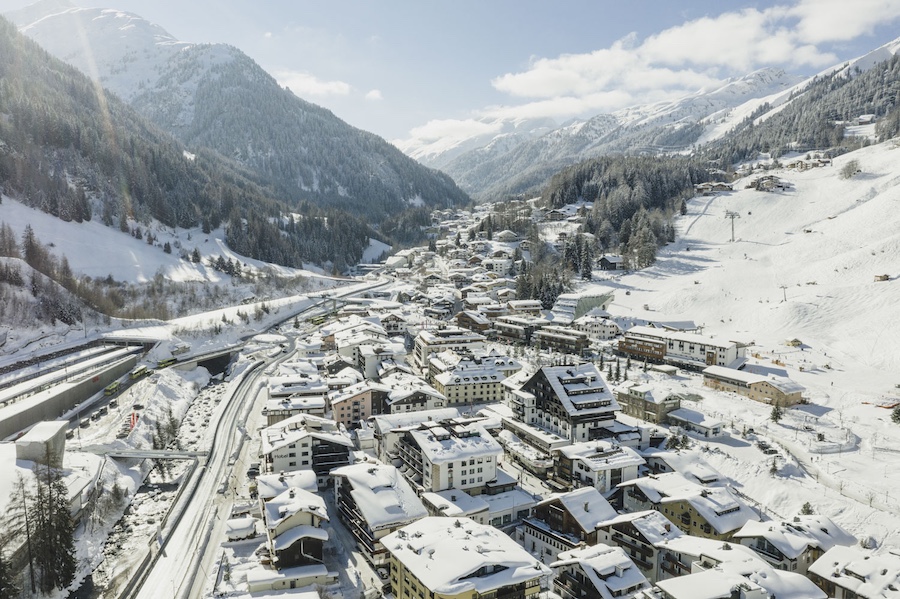
2. Austria: The All-Rounder
Austria consistently surprises skiers who arrive thinking it is the cheaper alternative to Switzerland or France. But it is not just cheaper; across most of the criteria above, it works better for more people.
Terrain
Austrian resorts are not the largest in Europe by piste kilometre count, but they are among the most varied. The Arlberg region, linking St. Anton, Lech, Zürs, and Stuben, covers 305km of marked runs across every ability level and 200km of off-piste variants, according to Ski Arlberg. What the Arlberg does particularly well is the combination of genuine steep terrain alongside wide, open runs that intermediate skiers can lap all week without repeating themselves.
Cost
Austria’s lift pass is no longer the bargain it once was, but the overall trip still costs less. Ski Arlberg’s 2026/27 6-day adult pass is €468 in peak season (19 December 2026 to 2 April 2027) and drops to €395 in the Wedel and Sun Ski Weeks in early December and April. At peak, that makes it slightly more expensive than the 3 Valleys or Zermatt pass. Austria wins on everything else: mid-range accommodation in St. Anton is noticeably cheaper than comparable options in Verbier or Courchevel, and mountain restaurant prices are meaningfully lower than in Switzerland. For a full budget, see our ski holiday in Austria cost breakdown.
Snow Reliability
St. Anton sits between 1,300m and 2,811m, with most of the high-terrain lifts operating above 2,000m. North-facing aspects on runs like the Valluga and Rendl hold snow into late March and April. The best time to ski in the Austrian Alps depends on what you are after—snow, value, or fewer crowds- and the answer is not the same for every skier.
Apres-Ski
The après-ski tradition in St. Anton is older and more embedded than anywhere else in the Alps. The Mooserwirt and Krazy Kanguruh have been running since the 1970s and 1980s, respectively. Austria did not adopt a bar-on-the-piste culture—it built one. If this matters to your group, then no other country can compete.
Accessibility
Innsbruck Airport is 90 minutes from St. Anton by road, Munich around 2.5 hours, and Zurich about 2 hours. That gives travellers 3 international airport options. For skiers flying from North America, the combination of direct transatlantic flights to Munich and Zürich, followed by a short drive, is one of the most straightforward international ski trip setups in Europe.
Family-Friendliness
St. Anton village is compact and walkable, which makes life easier with children. Parents can choose from various well-established ski schools and babysitting services available. The lift network is modern, queues are typically short outside peak weeks, and the range of terrain means family groups with mixed abilities can ski the same lifts together and then split off. For the full breakdown of what makes St. Anton the Arlberg’s flagship resort, read our complete St. Anton ski area guide: piste stats, terrain, and every lift in the system.
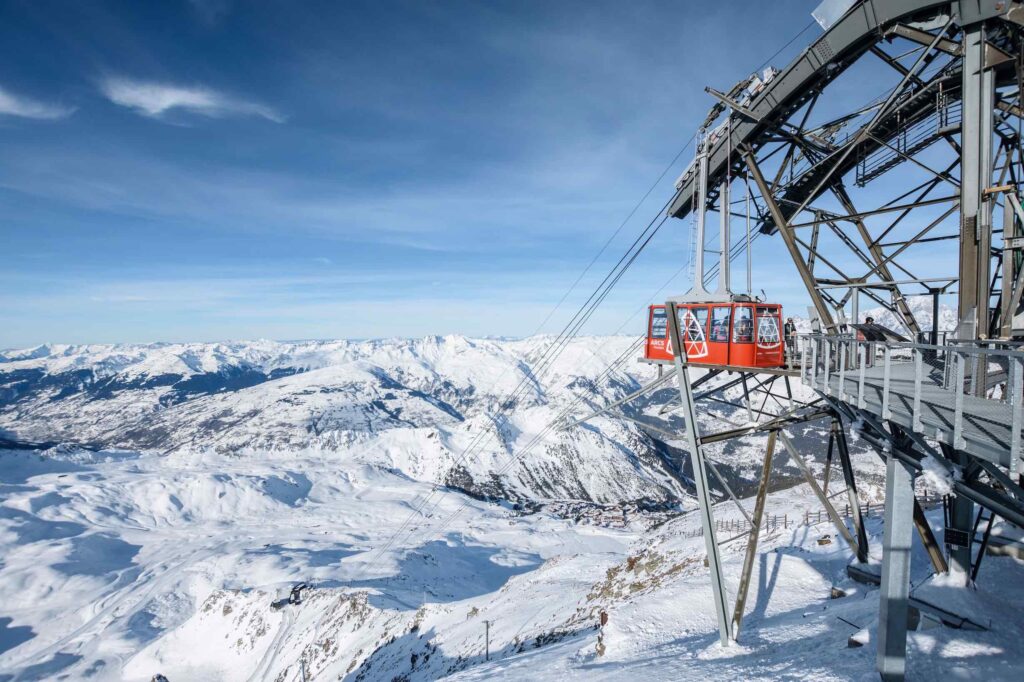
3. France: The Big Resorts
If you want scale above everything else, France is the answer. The 3 valleys Méribel, Courchevel, Val Thorens, and the surrounding villages are the largest linked ski area in the world at around 600km of marked piste, according to Les 3 Vallées. Val d’Isère and Tignes together form the Espace Killy, covering 300km at high altitude. Chamonix sits in its own category as a mountain town with serious off-piste credentials rather than a typical purpose-built resort.
Terrain
France wins on raw size. The Three Valleys take multiple weeks to explore properly even for strong skiers. Chamonix’s Vallée Blanche, a 20km off-piste descent from the Aiguille du Midi, is one of the most iconic routes in the Alps and has no equivalent elsewhere. Val Thorens, at 2,300m base altitude, is the highest ski resort in Europe and has the strongest high-altitude skiing of any French resort.
Cost
France is not cheap. The adult 6-day 3 Valleys ski pass for 2026/27 is €421 (according to les3vallees.com. Courchevel 1850 is one of the most expensive ski resorts in the world for accommodation. Even in mid-range resorts like Méribel, peak-week prices push significantly above what comparable quality costs in St. Anton. The package holiday market in France is well developed, which can pull overall costs down if you book through the right operators—but the pass price is fixed either way.
Snow Reliability
The high-altitude resorts perform well. Val Thorens at 2,300m base, and Val d’Isere and Tignes with lifts reaching 3,450m, have strong natural snow records and extended season windows. Lower resorts like Chamonix (1,035m village altitude) can be inconsistent, particularly in December and early January. Snowmaking has improved across French resorts over the past decade, but the best snow reliability in France is found at altitude.
Apres-Ski
France has good bars and excellent restaurants, but it does not have Austria’s après-ski culture. The scene in Méribel, particularly around the MO Bar and Dick’s Tea Bar, is active during peak weeks. Val d’Isère has a reasonable bar strip in town. But the habit of stopping at a mountain bar at 3 pm in ski boots while the lifts are still running is the thing that defines Austrian après-ski, and is not part of how France works. Evenings tend to centre on restaurants rather than bars.
Accessibility
Geneva Airport is the main gateway for most French resorts, followed by Lyon and Chambéry. Transfer times from Geneva range from around 90 minutes for Les Gets to 3.5 hours for Val d’Isere in normal conditions. Road access into French valleys involves mountain passes that can slow down or close in bad weather. TGV train services to Moutiers and Bourg-Saint-Maurice have improved connections, but the final section always requires a mountain road or resort shuttle.
Family-Friendliness
The ESF (École du Ski Français) network is large and generally well organised. Beginner and progression terrain is good in most resorts, and purpose-built areas like the village of Les Gets in the Portes du Soleil suit families with young children better than the larger, more spread-out resorts. Courchevel and the Three Valleys area can feel overwhelming for families with very young children; the area is simply too big to navigate easily on foot.
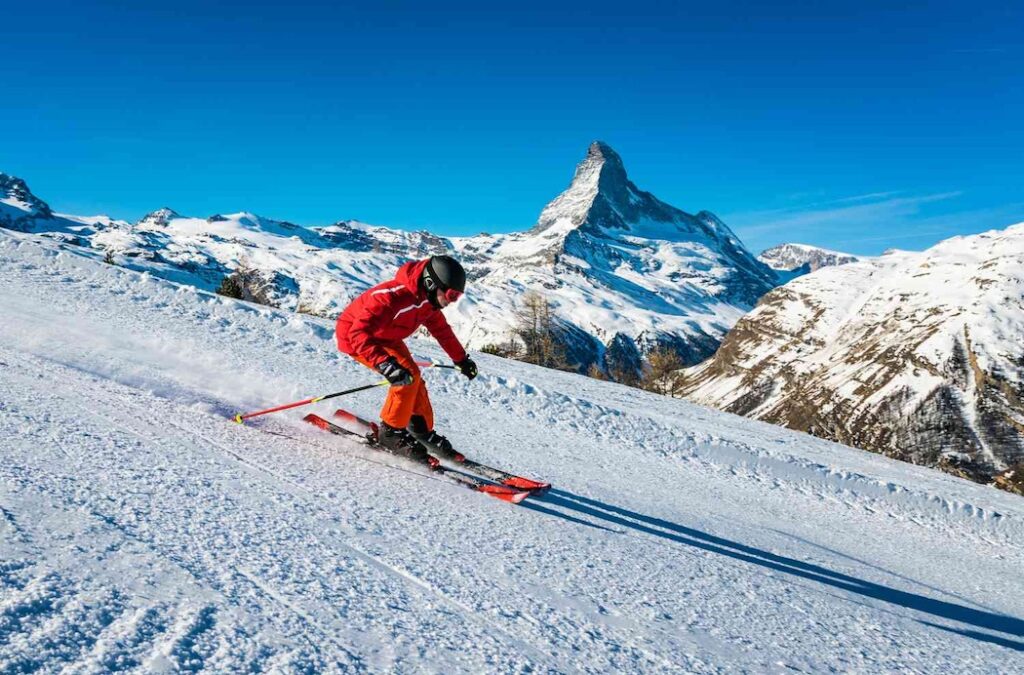
4. Switzerland: The Premium Option
Switzerland is where you go when the experience being exceptional matters more than the cost of it being so. Zermatt under the Matterhorn, Verbier with its freeride reputation, St. Moritz with its long-standing glamour — these resorts have defined premium ski holidays for generations. The trade-off is price, and it is a significant one.
Terrain
Switzerland’s flagship resorts offer serious terrain at serious altitude. Zermatt connects to Cervinia in Italy via the Matterhorn Glacier Paradise, giving access to around 360km of linked skiing. Verbier is a consistent stop on the Freeride World Tour and attracts advanced skiers specifically for its off-piste. St. Moritz is more lifestyle-focused but still has a solid 350km of piste through the Engadin valley.
Cost
Switzerland is the most expensive of the three countries. The Zermatt 6-day adult ski pass for 2026/27 starts at CHF 384 (about €410), and it costs more on busier dates because Zermatt prices by date, according to Matterhorn Ski Paradise. Accommodation in Verbier runs 30 to 50 percent higher than comparable quality in St. Anton. Food and drink on Swiss mountains: a lunch for two in a mid-range mountain restaurant typically runs CHF 80 to CHF 120, and there is no way around this. Switzerland prices at a premium, and it delivers accordingly.
Snow Reliability
Switzerland has the most reliable snow conditions in the Alps at its top resorts. The Klein Matterhorn glacier in Zermatt sits at 3,883m and offers skiing year-round. Saas-Fee, Verbier, and Andermatt all have high-altitude terrain that holds snow consistently into April and May. For skiers who need heavy snow guarantees, early-season trips in November or late season in April, Switzerland is the safest choice in Europe.
Apres-Ski
Switzerland has refined hotel bars and excellent restaurants, but the après-ski scene is quieter than Austria. Verbier has the most active après setup of the major Swiss resorts, with bars around Place Centrale staying busy through the early evening. Zermatt is more reserved; the hotels are outstanding, the town is beautiful, but the energy level by 5 pm does not compare to St. Anton. If après-ski is a deciding factor, Switzerland is not the right choice.
Accessibility
Geneva is the main entry point for Verbier, Crans-Montana, and the Valais resorts. Zurich connects better to the eastern resorts. Zermatt is car-free, which means everything arrives by train from Tasch, a logistical consideration worth planning around when travelling with ski equipment. Transfer times from Geneva to Verbier are around 2.5 to 3 hours. Switzerland has excellent train infrastructure within the country, which partly offsets the longer road distances.
Family-Friendliness
Swiss ski schools are among the best organised in Europe. Resorts are impeccably maintained, the lift infrastructure is modern, and you are unlikely to have bad experiences on any operational front. However, cost is the practical constraint for families. A week in Verbier with ski lessons for 2 children, accommodation, and lift passes adds up quickly. The same trip in Austria will cost noticeably less without a meaningful drop in quality.
5. Side-by-Side Comparison
Lift pass figures are official adult 6-day rates for the 2026/27 main season. Sources: skiarlberg.at (Austria), les3vallees.com (France), matterhornparadise.ch (Switzerland). Transfer times are from the nearest major international airport in typical road conditions.
| Category | Austria (Arlberg) | France (Three Valleys) | Switzerland (Zermatt) |
|---|---|---|---|
| 6-Day Lift Pass (adult) | €468 peak (€395 Wedel/Sun weeks) | € 421 | CHF 384 (~€410) |
| Airport Transfer Time | 90 min (Innsbruck) | 2-3.5 hrs (Geneva) | 2.5-3 hrs (Geneva) |
| Linked Ski Area | 305km (Arlberg) | 600km (3 Valleys) | 360km (Zermatt/Cervinia) |
| Top Lift Altitude | 2,811m (Valluga) | 3,230m (Cime de Caron) | 3,883 m (Klein Matterhorn) |
| Season Reliability | Dec – Apr | Dec – May (altitude) | Nov – May (glacier) |
| Après-Ski Culture | Outstanding | Moderate | Quiet/Refined |
| Beginner Terrain | Excellent | Good | Good |
| Off-Piste Reputation | World-class | World-class | World-class |
6. Which Country Suits Which Skier?
Choose Austria if you…
- Want excellent skiing without the price premium of Switzerland or peak-season France
- Value après-ski as part of the holiday, not just something that happens after skiing
- Are travelling as a mixed-ability group, beginners through experts, and need one resort to work for everyone
- Are flying from North America and want shorter transfers from multiple gateway airports
- Want a compact village that is walkable, not a sprawling resort spread across multiple villages
Austria is consistently rated as the best ski holiday for American skiers; the combination of airport access, transfer times, and value for money is hard to beat when flying from the US.
Choose France if you…
- Want the largest possible ski area and plan to spend a full week or more exploring different valleys
- Are an advanced or expert skier and want the widest possible choice of high-altitude, off-piste terrain
- Are comfortable booking via an established package operator and want a well-worn holiday infrastructure
- Prioritise mountain restaurants and evening dining over après-ski bar culture
Choose Switzerland if you…
- Have a flexible budget and want the most premium resort experience available in Europe
- Need strong snow guarantees in early November or late April and glacier access
- Are a freeride or backcountry skier specifically drawn to Verbier’s reputation or the Zermatt off-piste
- Want an iconic resort name as part of the trip; Zermatt under the Matterhorn is a genuine experience
A note on Italy
Italy, especially the Dolomites and the Aosta Valley, is worth considering for skiers who put food, scenery, and value at the top of their list. The Sella Ronda circuit in the Dolomites is one of the most visually striking ski routes in the Alps. Mountain restaurant quality in Italy is generally higher than in France or Switzerland at equivalent prices. The trade-off is snow reliability: Italian resorts tend to sit lower than their French and Swiss counterparts, and lift infrastructure in some areas lags behind. It is not the first choice for snow reliability, but for the right skier it belongs in the conversation.
7. The Verdict: Why We Keep Coming Back to Austria
France has scale. Switzerland has prestige. But when you assess which country gives the most complete ski holiday for the broadest range of skiers, Austria comes out ahead.
The combination of world-class terrain, genuine après-ski culture, accessible airports, reasonable prices, and village character that feels lived-in rather than constructed around tourism is difficult to find elsewhere in the Alps. St. Anton, in particular, has been earning its reputation for over a century, and it still holds up.
We are not neutral on this. Alpenature is based in St. Anton am Arlberg, and we chose to operate here because we believe the Arlberg is the best ski destination in Europe. We have also skied France and Switzerland extensively and the comparison holds. Austria also leads when it comes to the quality of its high-end properties; the Arlberg region consistently tops lists of luxury ski resorts in Austria for good reason.
8. How to Book Your Austrian Ski Holiday
Once you have settled on Austria, the practical question is how to put it together well. Accommodation, lift passes, airport transfers, ski hire, lessons, and any guided experiences all need to connect, and getting the timing or sequencing wrong on any one of them can affect the whole trip.
Made your choice? Let us plan your Austrian ski holiday. We handle accommodation, lift passes, transfers, and everything in between, with no mark-ups and no fuss.


