

The first thing you notice isn’t the view. It’s the peace and quiet.
Ten minutes out of the village, the hum of the gondolas fades behind a wall of snow-loaded spruce, and suddenly the loudest thing in the world is the squeak of your own footsteps. That contrast—from one of Europe’s busiest ski resorts to genuine alpine silence in under 15 minutes—is the whole appeal of snowshoe hiking in St. Anton. It’s also why snowshoeing keeps showing up near the top of the list when people look for things to do in St. Anton besides skiing.
This guide covers where to go, what the terrain actually feels like underfoot, what to pack, and how a guided day is structured.
Why St. Anton Is Built for Snowshoeing
St. Anton am Arlberg sits at 1,304 m, ringed by side valleys that hold snow deep into spring. The ski village maintains roughly 80 km of marked winter walking trails across 17 signposted routes—an unusually generous network for a town this size, and a genuinely useful backbone even when you plan to leave the groomed track.
Two things make it work particularly well:
- Access. Most trailheads are either in the village or a few minutes away on the free ski bus. No car, no long approach drive.
- Variety within a small radius. Flat riverside walking, forested valley floors, and steep panorama climbs all sit within about 20 minutes of each other.
There’s also the altitude factor. Locals and visiting athletes use these trails for endurance work precisely because the thinner air at medium altitude makes ordinary walking feel like real training. You’ll feel it on the first climb.
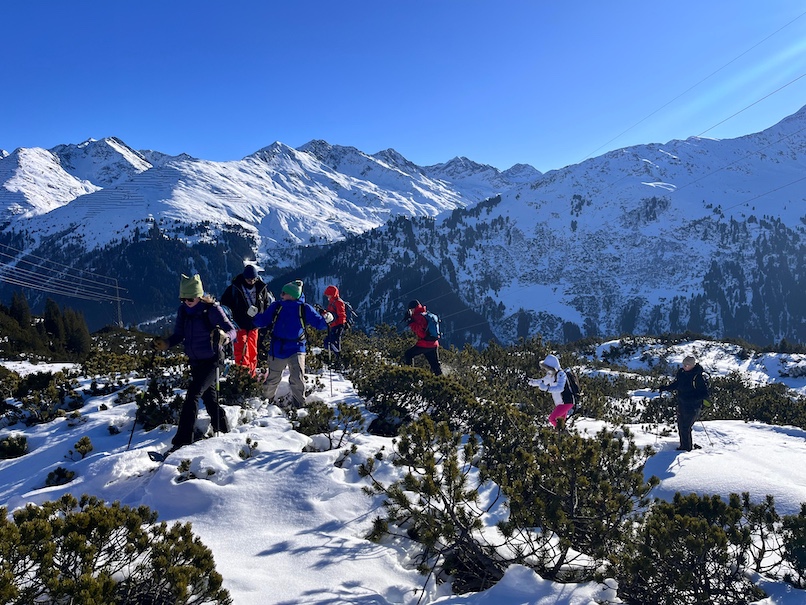
Best Snowshoe Routes in St. Anton
| Route | Distance | Difficulty | Best for |
| Verwall Valley | ~9.3 km (2.5 km short version) | Easy–moderate | First-timers, photographers |
| Nasserein to Munteck | ~5–7 km, steady climb | Moderate–hard | Fitness, panoramas |
| Galzig Panorama Trail | Short, high-altitude | Easy | Big views, low effort |
| Rosanna Riverside | Up to 18 km, flat | Easy | Recovery days, families |
Verwall Valley – The one everyone remembers
If you only do one route, do this one. From Mooserkreuz the trail runs roughly 10 km along the old Arlberg road into the Verwall, threading through snow forest before opening out at a 35 m steel suspension bridge and, further in, the Verwall reservoir basin. The Wagner Hütte at the valley mouth is the traditional stop—Tyrolean plates, sun terrace, no ceremony.
The beauty of the Verwall is that it scales. The Arlenbach-to-Salzhütte section is about 2.5 km if you want a taster, and the ski bus lets you cut the return short when legs give out.
Nasserein to Munteck – The fitness route
This is the one that earns you lunch. You start at Nasserein, warm up on the gentle rise through the Schöngraben Valley, then hit a sustained climb with a few sharp switchbacks. The reward is the Munteck viewing platform and a full sweep of the Stanzertal with the village laid out below.
Not a beginner’s first outing. Perfectly doable as a second.
Galzig Panorama Trail – Maximum view, minimum suffering
A newer route running between the top stations of the Galzigbahn and the St. Christophbahn. You ride up, you walk across the top of the world, you ride down. Ideal on a bluebird day when you want the high-alpine panorama without a 600 m climb. Worth knowing that lift access means you’ll want a valid pass—the complete St. Anton ski area guide breaks down which lifts are covered by what.
Jakobusweg, Vadiesen and the Rosanna – The quiet ones
The trails around St. Jakob (Friedheim to Gand, or the Römerweg over to Pettneu–Vadiesen) see a fraction of the traffic. So does the flat 18 km Rosanna path along the river. Good choices for a rest day, or when the avalanche bulletin says stay low.
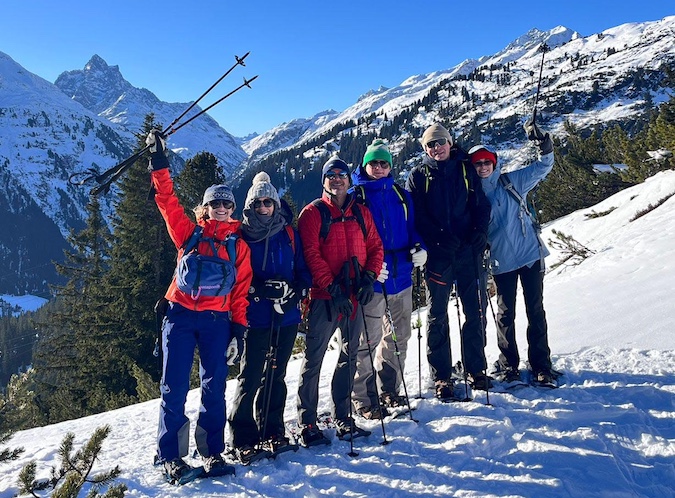
Snowshoe Gear Essentials
Rental shops in the village centre and at the valley stations kit you out in about ten minutes. What you bring matters more:
- Waterproof boots, mid or high cut. Snowshoe bindings need something stiff to grip. Trainers won’t work.
- Gaiters. Cheap, and the difference between dry shins and wet ones.
- Three layers, no cotton. You will overheat on the climb and freeze at the viewpoint. Plan for both.
- Poles with powder baskets. Usually included with rental; ask if they aren’t.
- Sunglasses and high-factor sunscreen. Snow reflects more UV than most people expect.
- Water and something in your pocket to eat. Snowshoeing burns considerably more than flat walking.
For anything off marked trails, transceiver, probe and shovel are non-negotiable—and so is knowing how to use them. Sports shops usually rent avalanche safety kits alongside the snowshoes.
Snowshoe Hiking Tips for Beginners
The technique is close to walking, with three adjustments:
- Widen your stance slightly. Snowshoes are broader than your feet; a normal gait clips the frames.
- Kick the toe crampons in on climbs. Step down and forward; don’t tiptoe.
- Sit back on descents. Heels first, weight behind you, small steps. It feels wrong for about four minutes, then it clicks.
Pace yourself early. Fresh snow can double the effort of the same distance on a packed track—an hour in powder is not an hour on a trail.
What to Expect on a Guided Snowshoe Hike
A typical Alpenature day starts with meeting your guide and collecting equipment at the rental shop. Your guide then picks the route based on three things: current snow conditions, the group’s fitness, and how much experience is in the group. That last part matters more than it sounds—the same valley in mid-January and late March is effectively two different hikes.
From there it’s a short transfer, a briefing on technique, then about three hours of walking with photo stops and breathers in between. Most tours finish at a mountain hut for lunch or back in the village. Groups run from four to ten people, with private sessions available for couples, families, or anyone who’d rather set their own pace.
When to Go
January and February deliver the deepest, driest snow and the emptiest trails. March brings longer days, softer light, and terrace weather—the season’s most forgiving month for beginners. December is atmospheric, but coverage in the side valleys can be thin.
Book a morning slot where you can. Snow firms overnight, walks better before noon, and the light is worth the early alarm.
Ready to Step Off the Piste?
Snowshoeing isn’t a consolation prize for people who don’t ski. It’s a genuinely different way to read a mountain—slower, closer, and far more attuned to what’s actually happening in the forest around you. It’s the same unhurried quality that makes winter in Austria feel different from winter almost anywhere else.
Book a guided snowshoe tour in St. Anton with Alpenature—local guides, all equipment sorted, routes matched to your group. Tours are fully refundable up to seven days before departure.


